
10605 Balboa Blvd., Suite 200 Granada Hills, CA 91344
16260 Ventura Blvd., Suite 600 Encino, CA 91436
555 Marin St., Suite 110 Thousand Oaks, CA 91360
Mon - Fri : 9:00 AM - 5:00 PM
PulmoCrit operates the PC Sleep Center — a fully accredited sleep facility serving Granada Hills, Encino, and Thousand Oaks. All studies are performed and interpreted by our own board-certified sleep medicine physicians — not outsourced — so your results and follow-up care stay within the same practice.
Our sleep medicine physicians are quadruple board-certified, including in Sleep Medicine. All studies are interpreted by our own physicians — not outsourced — ensuring continuity of care and same-practice follow-up.
Request a Sleep StudyWe perform the full spectrum of in-lab sleep studies, each tailored to address specific clinical questions.
A full overnight in-lab sleep study that comprehensively monitors brain activity (EEG), eye movements, muscle activity, heart rhythm, breathing effort, airflow, oxygen levels, and body position simultaneously.
This is the gold standard for diagnosing obstructive sleep apnea, central sleep apnea, parasomnias (sleepwalking, REM behavior disorder), narcolepsy, and other sleep disorders. Our technologists monitor you throughout the night and can respond to any needs in real time.
A split night study combines a diagnostic evaluation and a CPAP titration in a single overnight visit. During the first portion of the night, sleep is recorded to confirm the diagnosis of sleep apnea. If the apnea is confirmed and sufficiently severe, the second portion of the night is used to titrate CPAP therapy to the optimal pressure.
This approach is efficient and can reduce the time from diagnosis to treatment, allowing patients to begin therapy sooner.
For patients who have already received a diagnosis of obstructive sleep apnea and need their CPAP pressure precisely calibrated, an in-lab CPAP titration study provides the most accurate and comfortable pressure setting.
Unlike auto-adjusting CPAP devices that estimate pressure, a titration study allows our technologists to manually optimize your pressure setting in real time while monitoring your sleep architecture, ensuring the best possible therapeutic outcome.
BiPAP (Bilevel Positive Airway Pressure) delivers two different pressure levels — a higher pressure during inhalation and a lower pressure during exhalation. This is often more comfortable for patients who cannot tolerate standard CPAP, and is medically necessary for patients with more complex breathing disorders including central sleep apnea, hypoventilation syndromes, obesity hypoventilation, and neuromuscular diseases.
Our in-lab BiPAP titration study precisely optimizes both inspiratory and expiratory pressures under full polysomnographic monitoring.
Sleep disorders in children present differently than in adults and require specialized expertise to diagnose and interpret. PC Sleep Center is equipped to perform overnight polysomnography in pediatric patients, with technologists experienced in working with children of all ages in a calm and reassuring environment.
Common indications in children include snoring, suspected obstructive sleep apnea, bedwetting associated with sleep-disordered breathing, behavioral sleep problems, and parasomnias such as sleepwalking or night terrors.
One of the most common reasons patients struggle with CPAP or BiPAP therapy is an ill-fitting mask. Leaks, pressure sores, and discomfort are all avoidable with the right mask selection.
Our team offers dedicated in-office mask fittings, matching each patient to the style and size that best suits their face shape and breathing pattern — whether that's a nasal mask, full-face mask, nasal pillows, or a hybrid design. We also provide guidance on proper use, cleaning, and troubleshooting to maximize adherence and the effectiveness of your therapy.
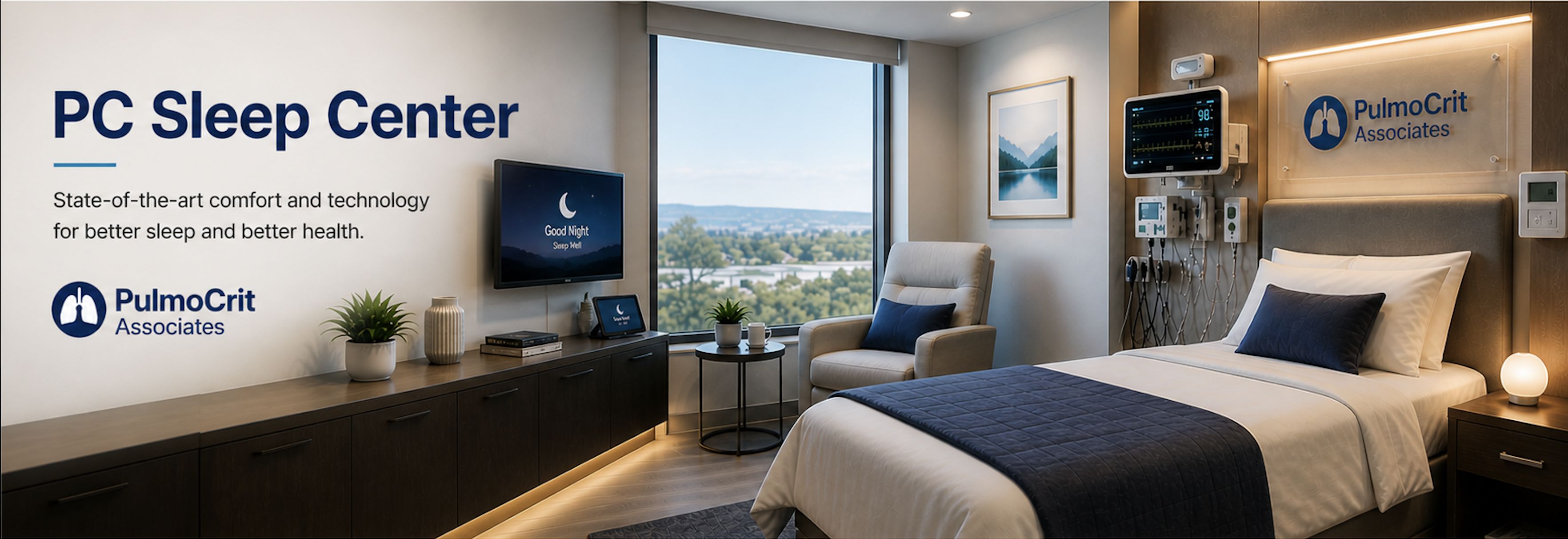
In-lab sleep studies are conducted overnight at PC Sleep Center in Encino — conveniently accessible from all three of our office locations (Granada Hills, Encino, and Thousand Oaks). Studies take place in a quiet, private room designed to feel like a hotel suite. A licensed sleep technologist will greet you, explain the process, and help you get settled.
Electrodes are placed on your scalp, face, chest, and legs using a mild adhesive or tape — no needles or injections. Sensors monitor brain activity (EEG), eye movements, muscle tone, breathing (via nasal cannula and chest/abdominal belts), heart rhythm (EKG), and blood oxygen (pulse oximeter on your finger). You will also be monitored with audio and video recording, which helps our team observe physical movements and breathing patterns throughout the night.
The technologist monitors your sleep from a nearby control room and may quietly adjust sensors if needed. A CPAP or BiPAP trial may be performed if significant sleep apnea is detected. You are woken up around 5:00 AM, sensors are removed, and you are free to return home or go to work. Results are reviewed by a board-certified sleep physician and sent to your referring provider within 1–2 weeks.
The most common sleep disorder — repeated airway collapse during sleep causing breathing pauses.
Learn MoreBreathing pauses caused by the brain failing to send proper signals to the breathing muscles.
Sleepwalking, sleep talking, REM sleep behavior disorder, and night terrors.
Excessive daytime sleepiness and abnormal REM sleep patterns.
Inadequate breathing during sleep related to obesity, requiring BiPAP therapy.
A cyclical breathing pattern seen in heart failure and neurological conditions.
Sleep-disordered breathing, snoring, and parasomnias in children of all ages.
Respiratory assessment during sleep for ALS, muscular dystrophy, and related conditions.
Our team will verify your insurance and confirm your appointment. Most sleep studies are covered by insurance with prior authorization, which we handle for you.
Request a Sleep Study Call (844) 428-5864Questions? Visit our FAQ page or call us directly. Our staff is happy to walk you through the process.