

10605 Balboa Blvd., Suite 200 Granada Hills, CA 91344
16260 Ventura Blvd., Suite 600 Encino, CA 91436
555 Marin St., Suite 110 Thousand Oaks, CA 91360
Mon - Fri : 9:00 AM - 5:00 PM
CPET is performed at our state-of-the-art PC Physiology and Metabolic Center — Encino. | Schedule your test →
Cardiopulmonary exercise testing — commonly called CPET or VO₂ max testing — is the most comprehensive non-invasive test available for evaluating how your heart, lungs, and muscles work together under physical stress. Unlike simpler exercise tests that measure only heart rate or oxygen levels, CPET simultaneously captures breath-by-breath gas exchange data while you exercise on a stationary cycle or treadmill, giving your physician an objective, physiologic window into why you become short of breath or fatigued with exertion.
CPET at PulmoCrit's PC Physiology and Metabolic Center — Encino
CPET performed at our Encino office — accessible from Granada Hills, Encino, and Thousand Oaks. Request a CPET →
CPET is the only test that can precisely and simultaneously measure the responses of both the cardiovascular and pulmonary systems during exercise. Resting tests — including spirometry, echocardiography, and chest CT — often appear normal even when patients experience significant exercise-limiting symptoms. CPET fills that diagnostic gap by stressing both systems together and capturing exactly where the physiologic limitation occurs.
Your physician may order CPET for the following reasons:
CPET generates a rich panel of physiologic variables that are interpreted together as a "fingerprint" of your cardiopulmonary response to exercise. Key measurements include:
VO₂ Peak / VO₂ Max
The maximum rate at which your body can consume oxygen during peak exertion. The single most important prognostic variable in CPET — used to quantify exercise capacity and guide therapy in PAH, heart failure, and pre-surgical risk.
Anaerobic Threshold (AT)
The exercise intensity at which lactic acid begins to accumulate faster than it can be cleared. A submaximal marker that can be detected even in patients who can't reach peak exertion, making it especially valuable in severely limited patients.
VE/VCO₂ Slope
Ventilatory efficiency — how much air you need to breathe to eliminate a given amount of CO₂. Elevated in pulmonary hypertension, heart failure, and some ILD patterns. One of the strongest prognostic markers in PAH.
Oxygen Pulse (O₂ Pulse)
A non-invasive surrogate for stroke volume — how much oxygen the body extracts per heartbeat. A flat or declining O₂ pulse during exercise can indicate cardiac limitation or reduced hemoglobin.
Breathing Reserve
How much ventilatory capacity remains unused at peak exercise. A low breathing reserve suggests pulmonary limitation (COPD, ILD); a preserved reserve with high heart rate suggests cardiac limitation.
SpO₂ During Exercise
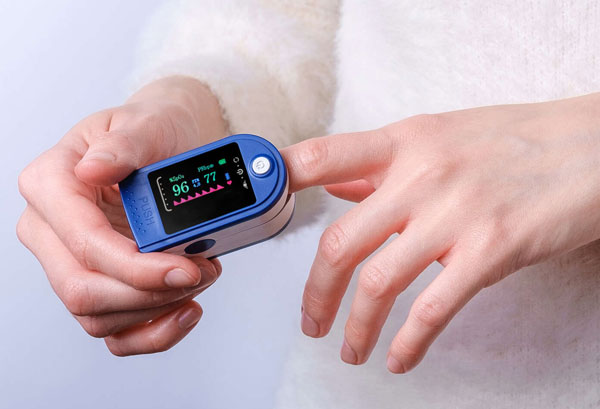
Continuous pulse oximetry throughout the test reveals exercise-induced desaturation, which may be absent at rest. Critical for ILD monitoring, oxygen therapy decisions, and detecting pulmonary vascular disease.
CPET is performed in our PC Physiology and Metabolic Center — Encino. The test typically takes 45–90 minutes from arrival to discharge. Here is what the visit looks like:
CPET is safe in the vast majority of patients. However, your physician will review your history before ordering the test. Absolute contraindications include:
If you have orthopedic limitations that prevent cycling, your physician may consider alternative exercise modalities or other functional assessments such as the six-minute walk test.
Because CPET is performed and interpreted by your PulmoCrit physician — not sent to an outside reading center — results are typically available and discussed at a follow-up visit within 1–2 weeks of the test. In urgent clinical situations, your physician will review the key findings with you sooner. You will receive a written interpretation that details each measured variable and how it informs your diagnosis and treatment plan.
A standard cardiac stress test (also called a nuclear stress test or ECG treadmill test) focuses on detecting coronary artery disease by monitoring heart rhythm and blood flow under stress. It does not measure how much oxygen your body uses or how efficiently your lungs and heart work together.
CPET provides a far richer physiologic dataset. It answers not just "is there a blockage?" but rather "why is this person short of breath — and which system is limiting them?" The two tests are complementary: a patient may need a cardiac stress test to rule out coronary disease and a CPET to characterize the functional impact of a known heart or lung condition.
Normal VO₂ peak values depend on age, sex, and body size. Reference ranges are established from large population studies, and your physician will compare your result to predicted values for someone of your age and sex. As a general benchmark:
However, no single number is interpreted in isolation. Your physician analyzes the full CPET dataset — including the anaerobic threshold, VE/VCO₂ slope, oxygen pulse, breathing reserve, and exercise-induced SpO₂ — to determine whether the limitation is pulmonary, cardiovascular, or related to deconditioning or other factors.
Both tests assess exercise capacity, but they answer different clinical questions:
| Feature | CPET | Six-Minute Walk Test |
|---|---|---|
| Data generated | Comprehensive: VO₂, VCO₂, HR, BP, ECG, SpO₂, ventilation | Distance walked, SpO₂, HR, Borg dyspnea score |
| Exercise intensity | Maximal (symptom-limited) | Submaximal (patient-paced) |
| Best used for | Diagnosing cause of dyspnea, pre-surgical risk, PAH prognosis | Serial monitoring, oxygen prescription, rehabilitation planning |
| Equipment required | Metabolic cart, cycle ergometer, ECG, specialized lab | Measured corridor, pulse oximeter, stopwatch |
| At PulmoCrit | Encino PC Physiology and Metabolic Center | All three office locations |
Many patients have both tests performed as part of a comprehensive physiologic evaluation — they provide complementary, not redundant, information.
Schedule Your CPET
Performed at our Encino PC Physiology and Metabolic Center · Results interpreted by your PulmoCrit physician · We respond within 1 business day.

A submaximal standardized exercise tolerance test used to monitor functional capacity in COPD, pulmonary hypertension, and ILD.
Learn More
Comprehensive in-office spirometry, lung volumes, and DLCO — often performed in the same visit as CPET for a complete physiologic evaluation.
Learn More
A thorough specialist workup of your respiratory symptoms — history, exam, imaging review, and a management plan tailored to your condition.
Learn More